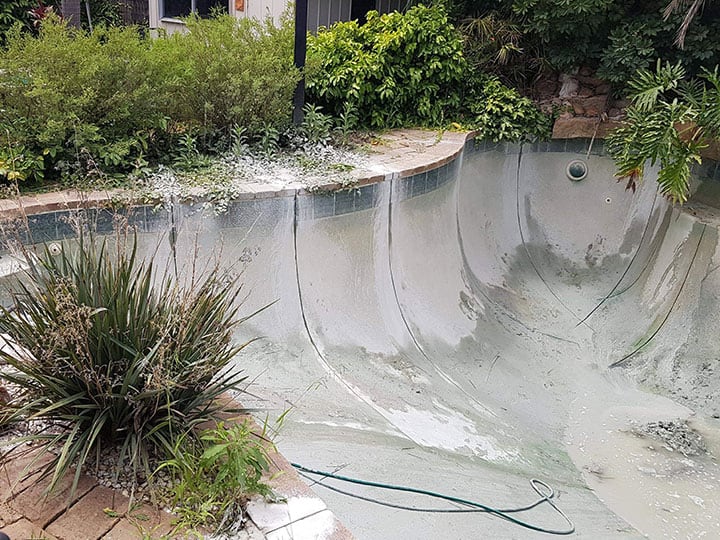
When it comes to getting rid of a swimming pool, Perth homeowners typically have two options.
The first is a fill-in, sometimes called a partial removal. This involves punching drainage holes in the base of the pool shell, breaking down the top edges of the pool wall and surrounding pavers, and backfilling the space with clean sand or soil before compacting it to match your existing garden levels. It costs less upfront and takes less time.
The second option is full removal. This means total shell demolition, complete material haulage, and excavating the entire pool structure from the ground, whether that’s concrete, fibreglass, or vinyl liner. Afterwards, you are left with a clean foundation. The hole is then backfilled and compacted to a certifiable standard. It’s the more expensive and time-consuming option, but with a better end result.
The price difference between the two is noticeable, so it can be tempting to go with the cheaper option. But what that difference actually buys you, or costs you, is the part that’s vital to consider.
The Myth of the Quick Fix: Why Infill Costs You More Than You Save
It’s simple, cheap, and it’s fast. If you’re selling your house, it’s the quickest way to get what you need. Some people even DIY. Break off the top rim, bring in some clean fill, compact it yourself, lay turf over the top and pocket the difference. On the surface, you’ll have a flat yard and some savings, but this method always has a negative impact on your property’s resale value.
A filled-in pool means there’s concrete or fibreglass buried underneath the ground. In Western Australia, that means the council would label that area as “non-buildable.” That means no deck, no extensions, no shed, no building at all. You’d also be required to disclose that in the contract of sale, which would affect your potential buyer pool. Ultimately, you save money on excavation and earthmoving, but your property value takes a hit, especially if the fill-in is not done by a professional to a certifiable standard.
A poorly executed infill will also cause structural issues down the line. Standard soil filling without professional compaction leads to sinkage over time. The result for the next owner is uneven ground, poor drainage and a section of yard that cannot support a secondary dwelling or any significant landscaping. In Perth’s coastal sand environment, specifically, an un-engineered fill job is particularly vulnerable to movement. Drainage problems that develop years later are difficult to trace back and expensive to fix.
For the buyers who do stay interested, the covered pool becomes a negotiation point. They’re not buying a clean backyard. They are buying a patch of ground with a concrete or fibreglass shell underneath it. That limits what they can build, how they can landscape, and what an engineer will sign off on. An alfresco, a granny flat, a heavy limestone retaining wall? None of these can be safely constructed over a buried shell without expensive piling engineering. The usable block size has been permanently reduced, even if it doesn’t look that way from the surface.
Why Full Swimming Pool Removal and Excavation Has the Best Return on Investment.
Full removal clears every obligation that came with the pool. No more annual maintenance costs, chemicals, water top-ups or electricity and no insurance, compliance inspections or safety liability. For a property that is tenanted or heading to market, these are reductions in ongoing costs. The money saved in the years following will eventually offset that upfront excavation cost as well.
Once one of our operators carries out a complete decommission, structural removal and engineered backfill, the pool no longer exists from a legal or structural standpoint. There is nothing to disclose, and the yard looks like a pool never even existed there.
Buyers, landscapers and builders will now see a site they can actually build on, landscape properly or hand to a contractor without a feasibility study first. That is what drives competition at the point of sale, with the potential for future landscaping as well as building permits for extensions or secondary dwellings.
When our bobcat operators and their teams complete a full removal, we arrange for a compaction certificate to be provided upon completion. That certificate confirms the ground is stable, properly compacted and meets the same standard as the rest of the block. This adds property value when selling the home.
There are also two buyer demographics worth considering specifically. Downsizers, who want a low-maintenance property with no compliance obligations attached. And young families with children, who see a pool as a safety liability, not a feature. Together, these two groups represent a sizable share of the Perth market right now. A properly cleared swimming pool captures both of them, while a disclosed infill captures neither.
What to Do Before You Decide
If your pool is ageing, underused or sitting on a property you are planning to sell, a full removal is a serious consideration. At Active Bobcats, we carry out pool excavation and removal across Perth. We also take care of removing all debris after the excavation is complete, leaving the site clean and tidy.
If you want a straight answer on cost, scope and what swimming pool removal would look like for your specific site, get in touch, and we will come out and assess before providing a comprehensive quote.